Option Buying With Order-Block
Option buying with small capital, made simple: why most option buyers arrive late, how time decay eats the premium, and how order blocks show the zone early.
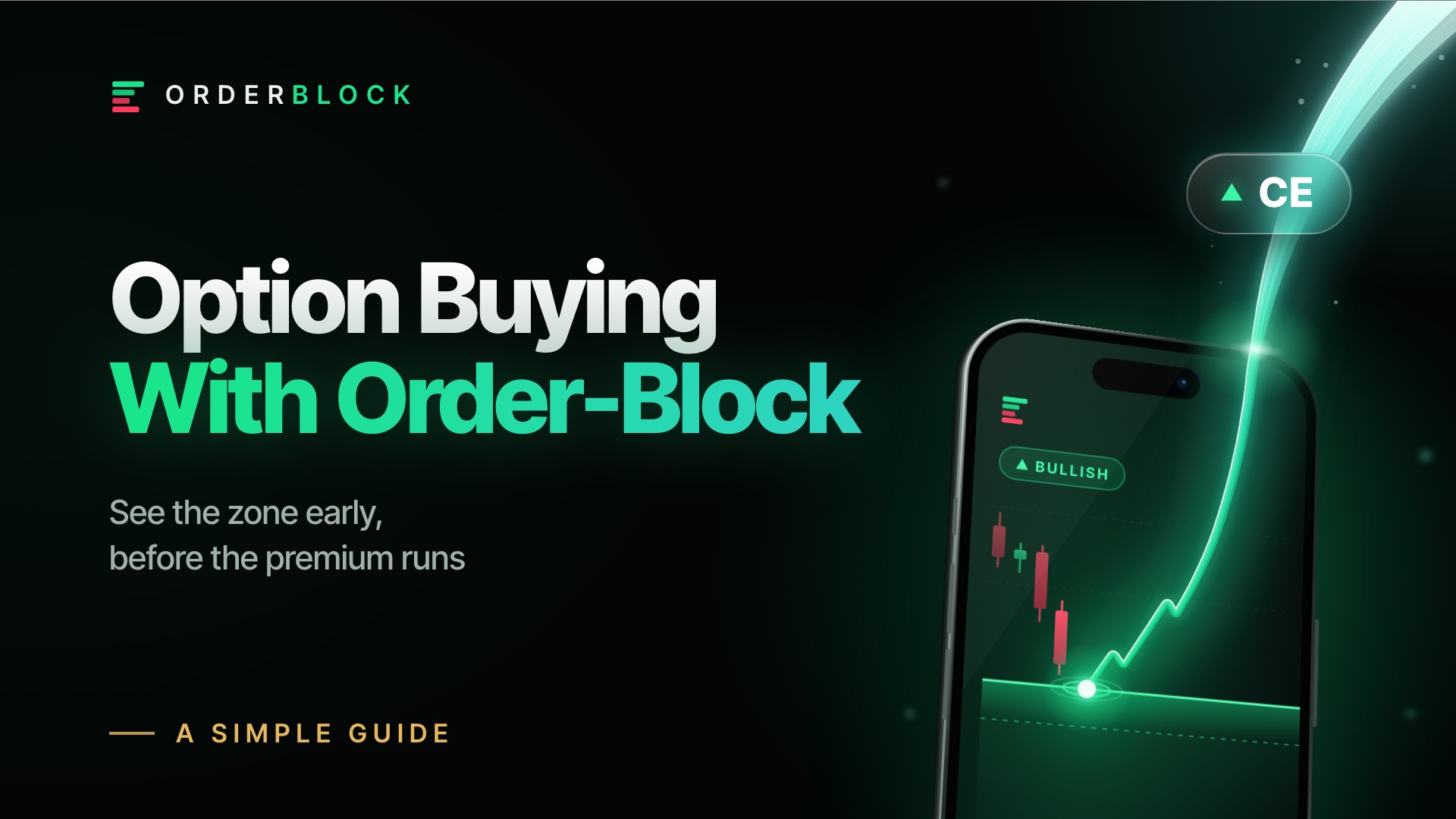
Most traders start with option buying for one reason: small capital. A few thousand rupees can follow a move that would cost lakhs in shares. And when a stock moves fast, its option premium moves many times faster.
Yet a SEBI study found that about 9 in 10 option buyers lost money in FY26. A common way to lose: the right stock, at the wrong minute.
In the pictures below, you follow one example F&O stock and its call option through a single trading day. First you live it the way most option buyers do. Then you see the same day with the order block zone marked.
Option buying for small traders: a small premium, a big move
Take an F&O stock at ₹1,498.80 at 11:05. Its 1520 call option (CE) costs ₹12.05 a share: less than 1% of the stock's price.
By 13:05, the stock is at ₹1,546. That is a move of about 3%. In the same two hours, the call goes from ₹12.05 to ₹36.55: about 3 times.
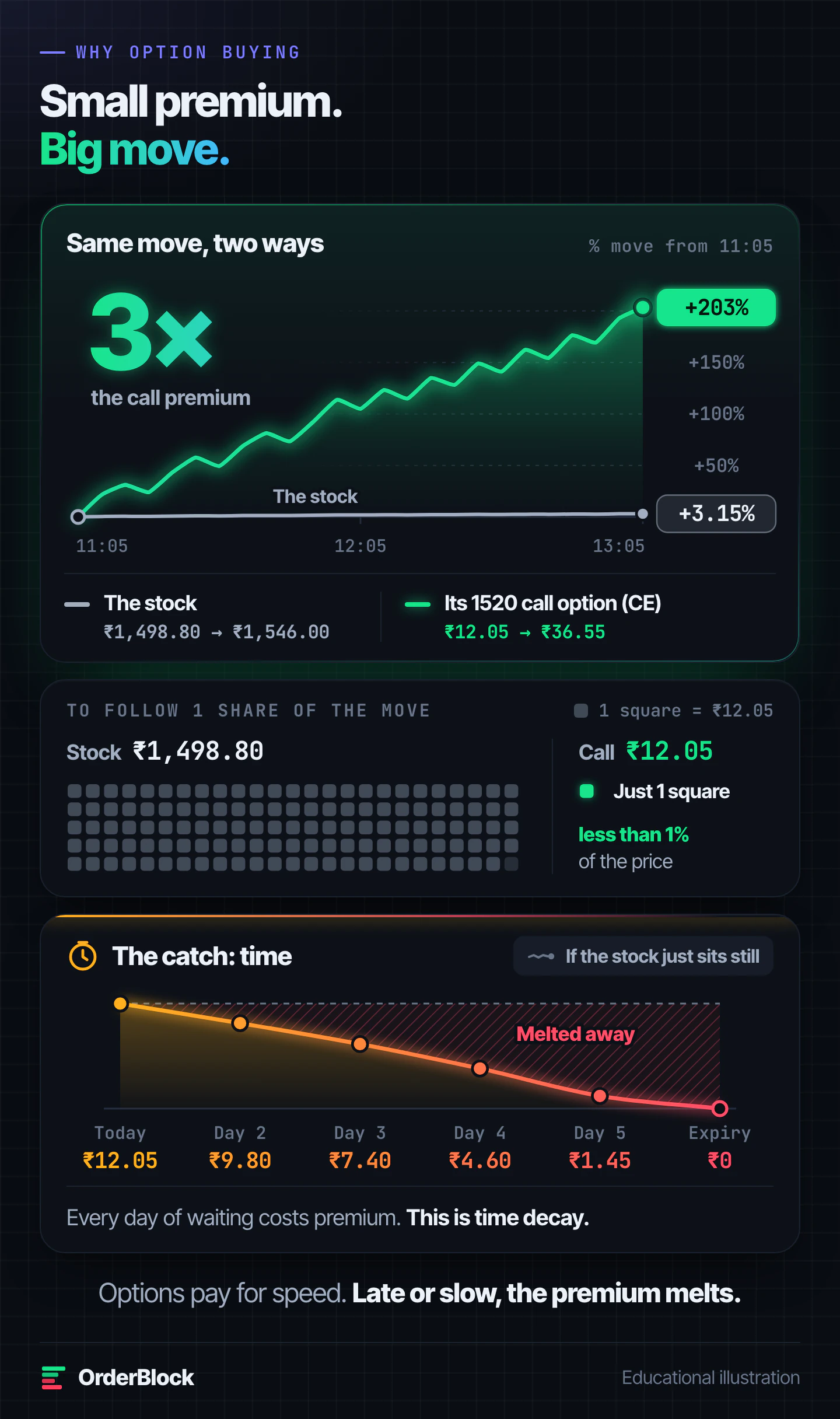
That is why small traders love option buying: a small premium can catch a big move. But look at the bottom of the picture. If the stock just sits still, the same call loses value every day, faster as expiry gets closer: ₹12.05 today, ₹9.80 the next day, ₹0 at expiry. This is called time decay.
So an option buyer needs two things: the right stock, and the right minute. A call option rewards a fast move that starts soon. Being right late is not enough.
Why most option buyers lose money: the wrong minute
Here is how it usually goes. A stock jumps with three big green candles. You see it, you feel the rush, and you pay ₹19.00 for the call, near the top of the jump.
Then price slips back. Your premium drops to ₹12.05, down 37%. It feels like the trade is failing, so you give up.
Minutes later, the stock turns and runs. The call you let go at ₹12.05 climbs to ₹36.55. Without you.
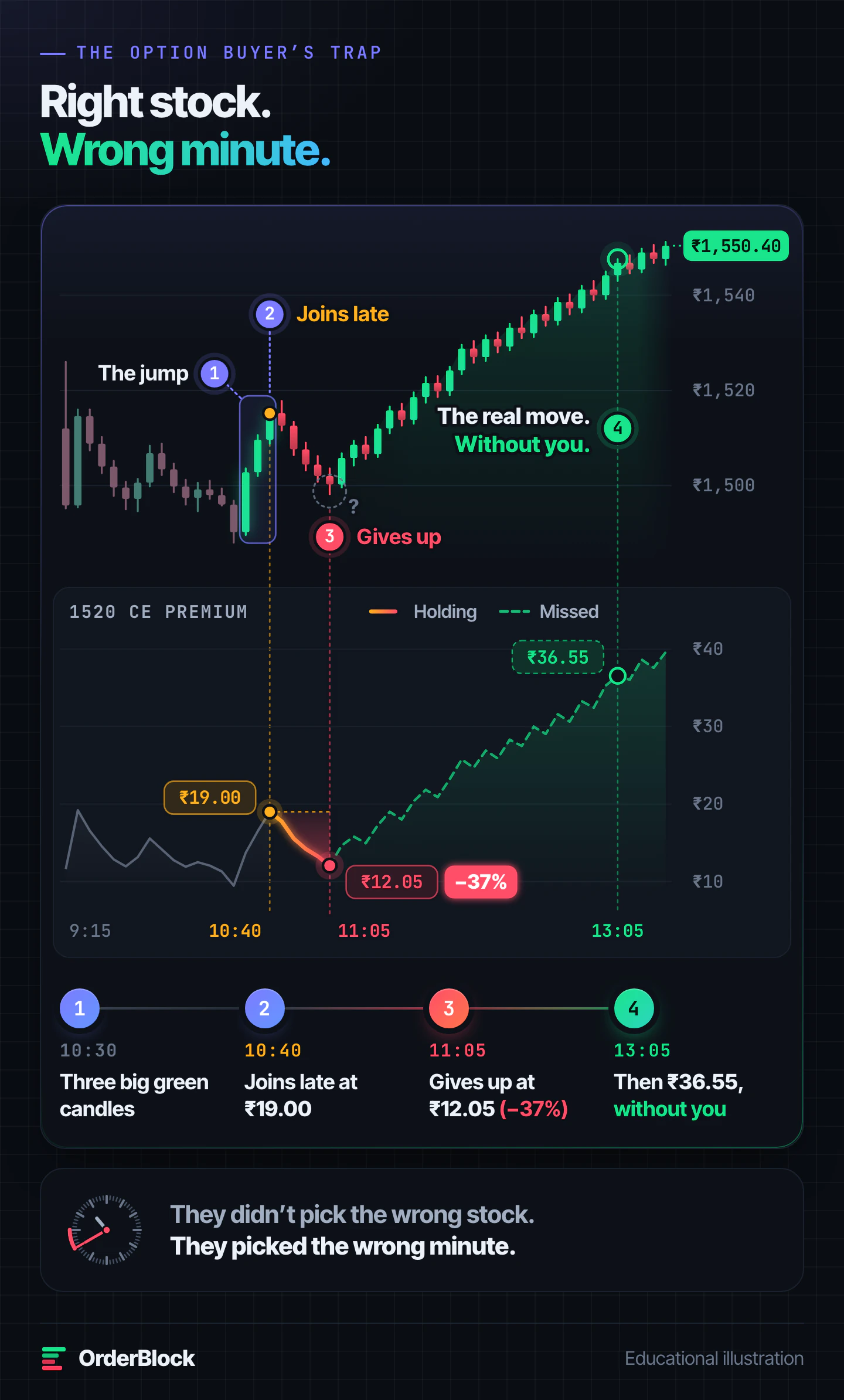
Nothing was wrong with the stock. You arrived after the first jump, and gave up exactly where the real move began. That spot has a name: the order block zone.
Order block and liquidity, made simple for option buyers
An order block is big money's unfinished business: a price zone where large orders were left waiting, ready to turn price again when it returns.
Big players (mutual funds, foreign investors, big trading firms) trade in sizes no single price can fill. They grab what is on offer, price jumps away before they are done, and the unfilled part stays parked at the zone. That waiting money is what turned price at the dip that scared our late option buyer.
Liquidity is the second clue. It is a pile of stop orders resting under an obvious low or above an obvious high. A big player needs lots of orders on the other side to fill a huge order, and a pile of stops gives exactly that. In our day, price first dipped under two equal lows and took the stops there. The next pile sat above the morning high.
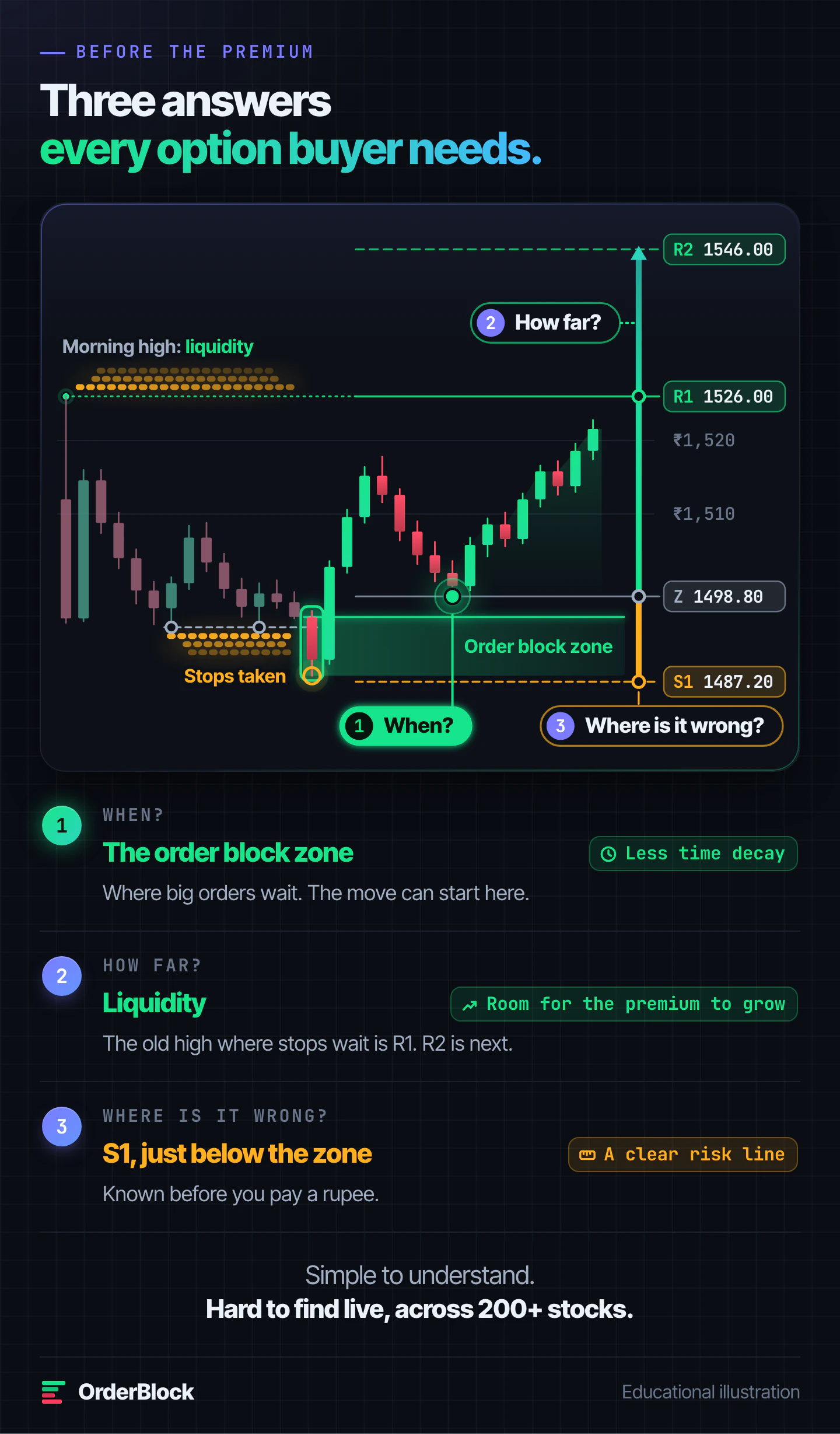
Together they answer the three questions behind every option trade. The zone tells you when a move can start, so time decay gets less time to eat your premium. Liquidity tells you how far it may run: R1 at the morning high, then R2. And S1, the support just below the zone, tells you where the idea is wrong. In our day, a break of S1 would have taken the call to about ₹8.35, a line you could see before paying ₹12.05.
On a Bearish chart it works upside down: the big orders wait above price, the zone acts as resistance, and that is where put option buyers look.
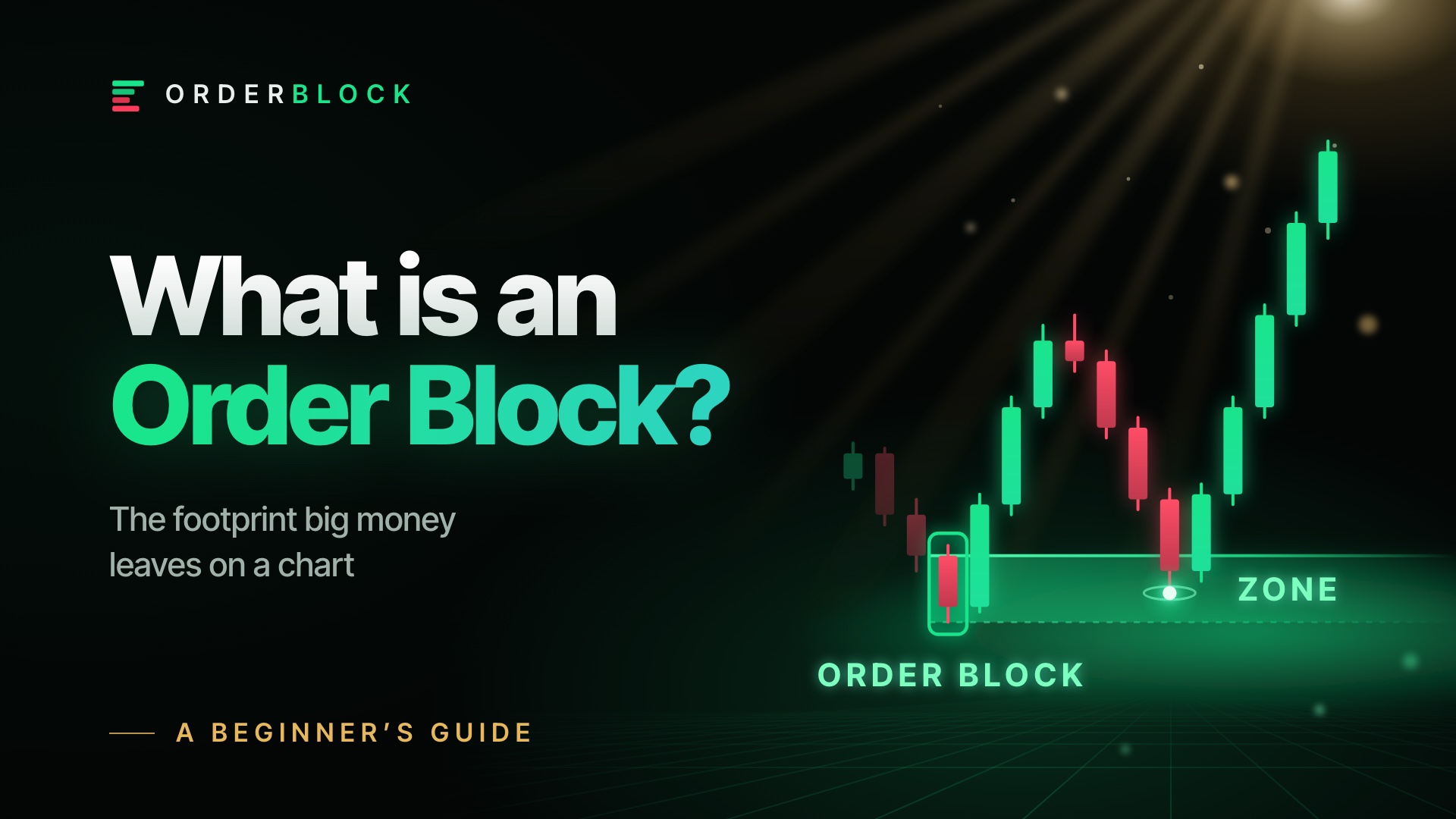
Want the full picture first? Read what is an order block, our beginner's guide in pictures.
Time decay and fake order blocks: same candles, different premium
If that sounds easy, here is the catch. Every chart is full of dips that look like a zone, and most have no big money behind them at all.
For an option buyer, a lookalike costs twice. The stock drifts instead of moving, and the premium melts while you wait. That is also why the late option buyer couldn't simply hold on: in the moment, a real zone and a lookalike dip look exactly the same.
Picture two stocks, on two different days, with the very same candles up to the zone:
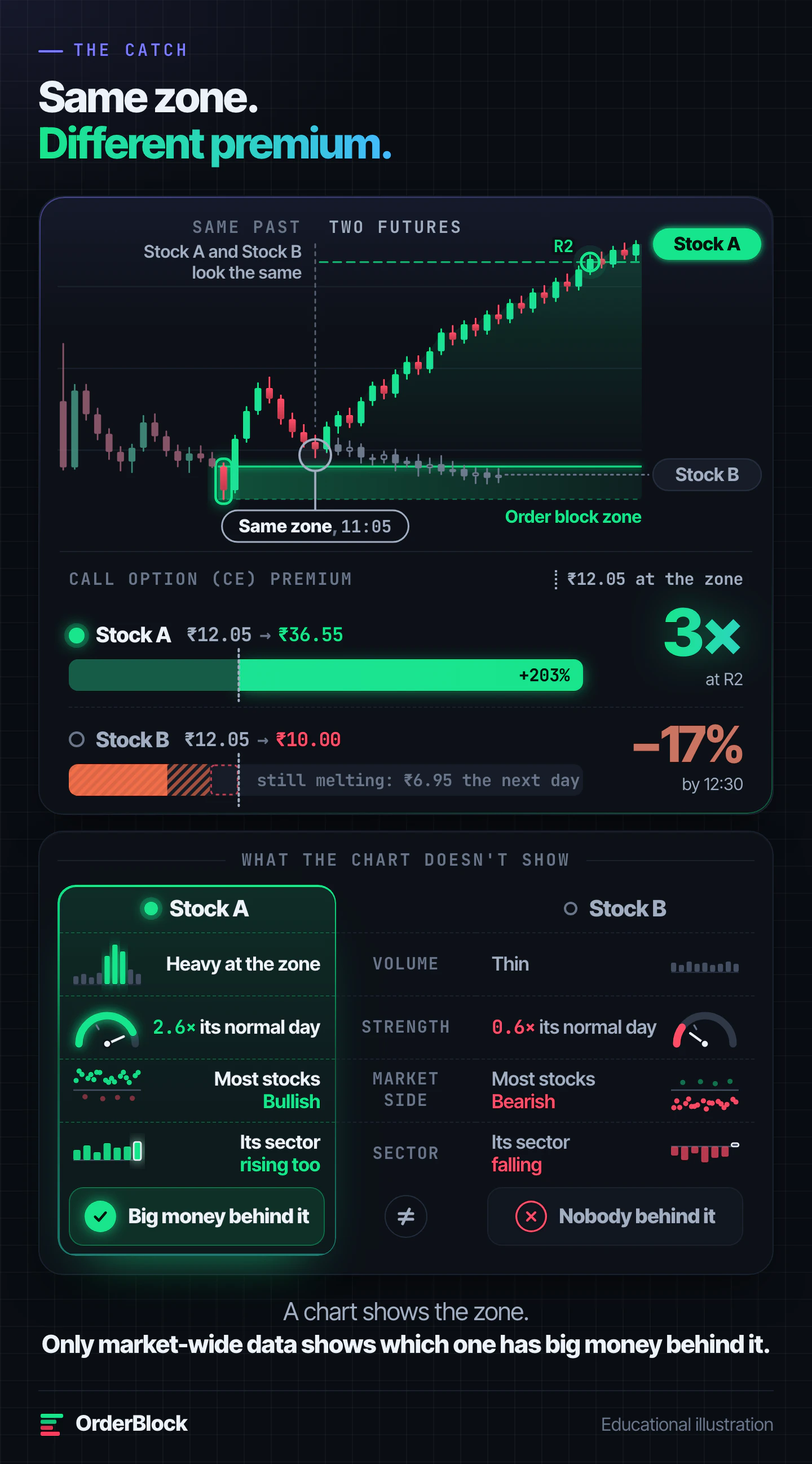
The difference lives in data one chart can't give you:
- Volume: was there heavy trading at the zone, or a thin drift that leaves your premium waiting?
- Strength: is the stock moving far more than on a normal day? Slow stocks feed time decay.
- Market side: are most F&O stocks moving your way right now, or against your call?
- Sector: is the stock's sector moving with it, or is the stock moving alone?
- Strict rules: does every zone pass the same tough checks, on finished 5-minute candles?
Most of that isn't on any one chart. It takes the whole market's data, live.
Option buyers can't check 200+ F&O stocks in time
Now picture doing that for 200+ F&O stocks at once. Every 5 minutes a new candle closes on each of them, and any one can make a zone or break one. Checking each chart for just one minute takes over three hours. By then, the picture has changed about 40 times.
An option buyer has even less time. While you scan, the move starts, the premium gets expensive, and you turn into the late option buyer from our story.
Order block zones for option buyers, found every minute
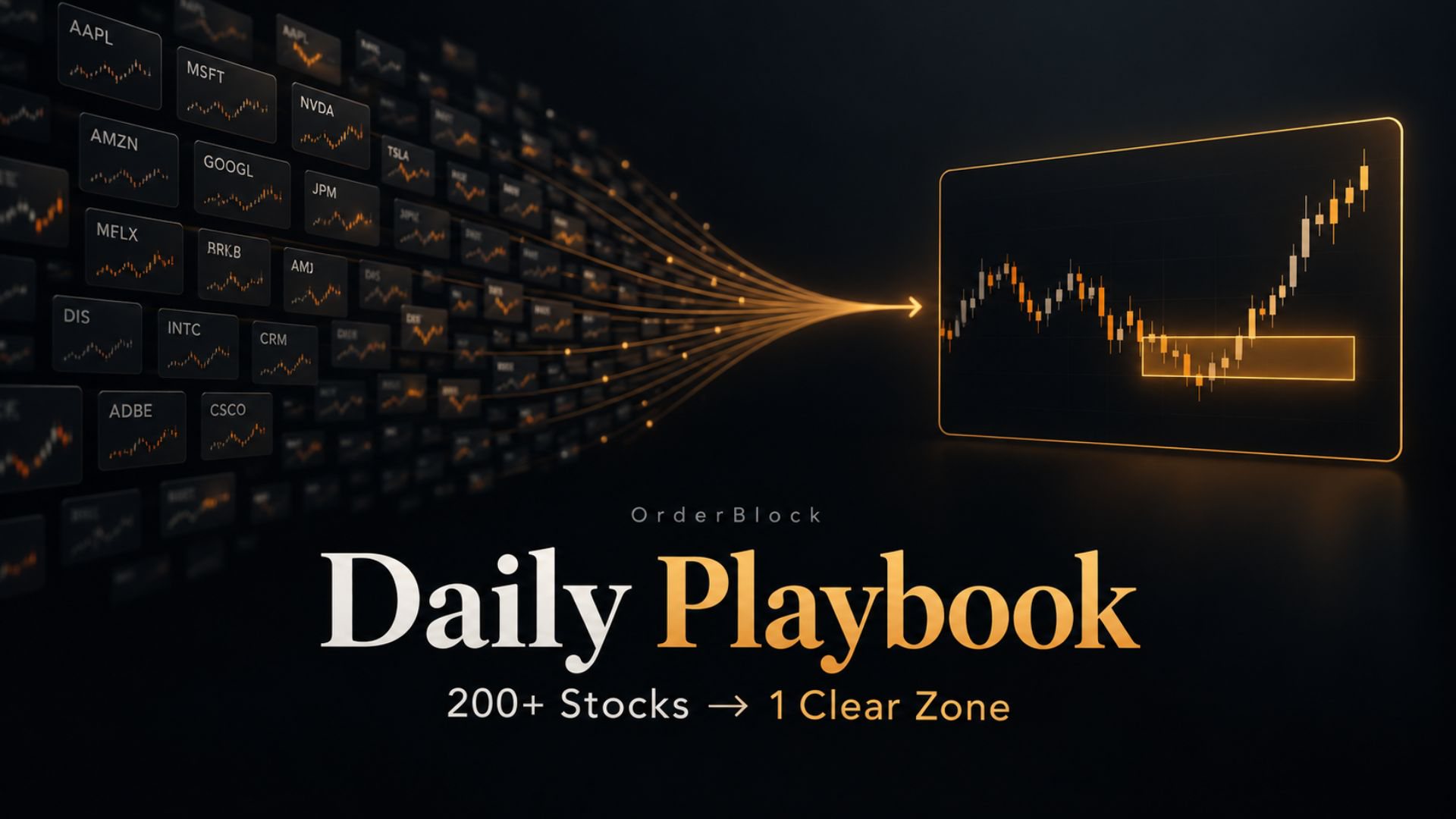
So we built OrderBlock to do that scan for you. Every minute, two seconds after the candle closes, it checks 200+ F&O stocks. It scores each one's move today against its normal day, reads its volume and shows which side the market is on.
The 20 strongest Bullish and the 20 strongest Bearish get an order block zone, drawn with the same strict rules every time. Each zone comes with its levels: Z for the zone, S1 where the idea is wrong, and R1 and R2 for the room ahead. On a Bearish chart they flip: R1 above is where the idea is wrong, and S1 and S2 below are the room. Six of these stocks, 3 a side, become the picks.
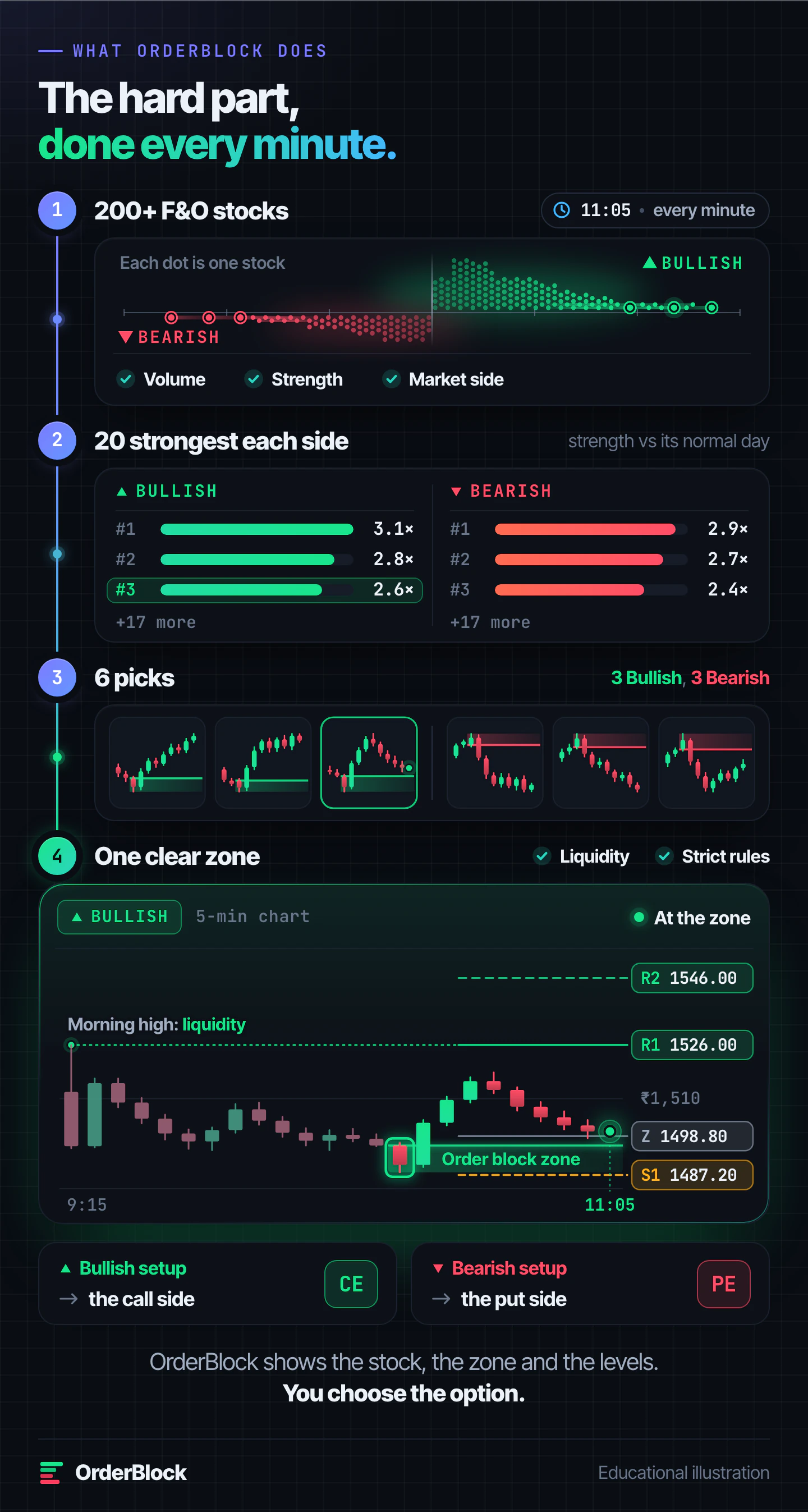
A Bullish setup is where call option buyers look. A Bearish setup is where put option buyers look. OrderBlock shows you the stock, the zone and the levels. You choose the option. It all runs on your phone or computer, with no broker login.
Since the check repeats every minute, the zone is already on your screen when price comes back to it. Look at step 2 below: the zone was on the chart while the late option buyer was paying ₹19.00 at the top of the jump. Early doesn't mean first. It means being there when price returns to the zone, before the big move.
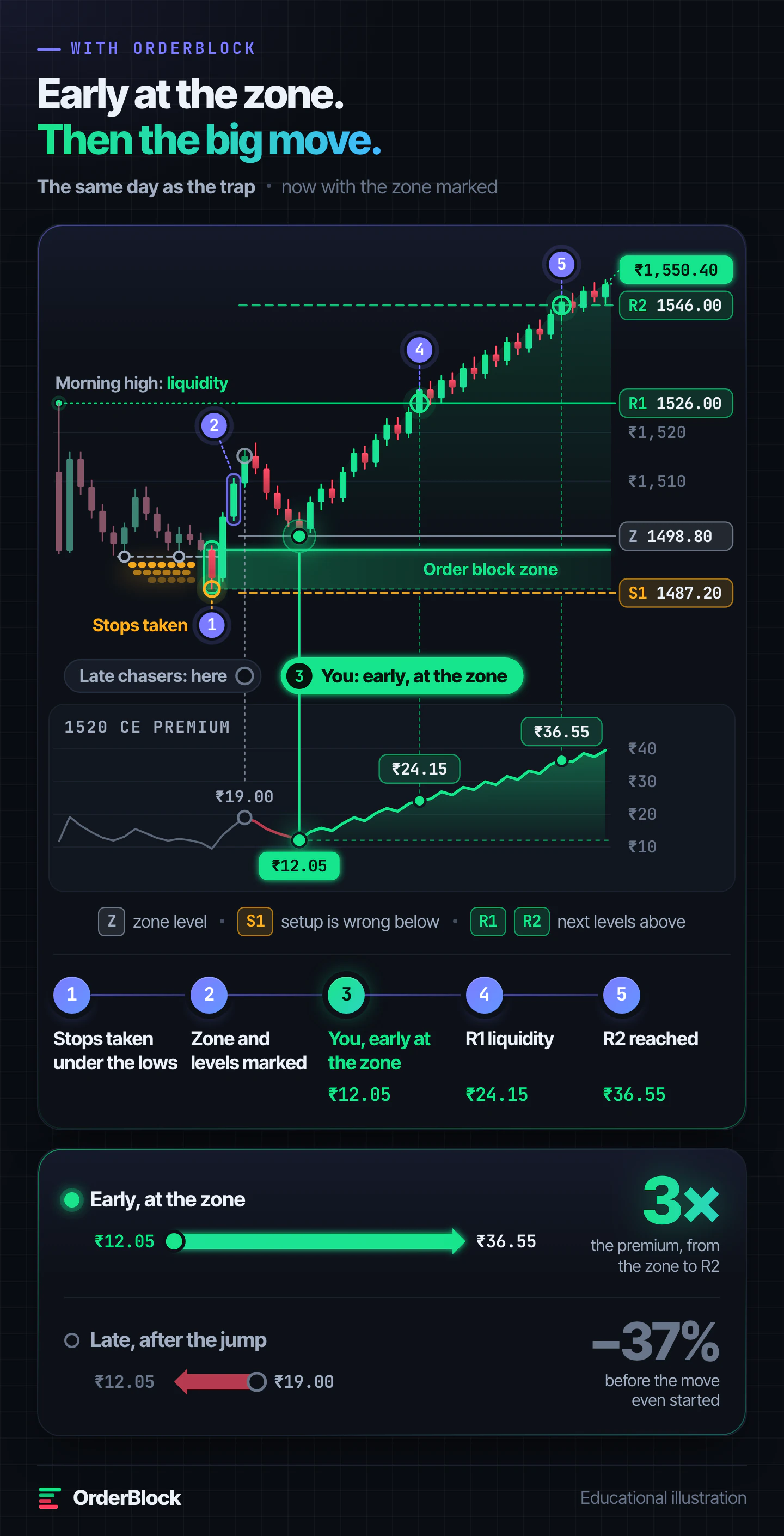
Same stock. Same candles. Same call option. Only the minute changed.
What members say
The tool helps me think in terms of process rather than hope. That has made me much more selective in the trades I take.
Gaurav Bhide, options trader, Pune
On expiry days especially, the tool helps me avoid overtrading by narrowing my focus. That has improved my discipline a lot.
Rahul Khandelwal, option scalper, Jaipur
Earlier I used to depend on Telegram chatter for stock ideas. Now I trust my own shortlist because the data here is much more structured.
Saurabh Yadav, independent trader, Noida
Your premium is small. Spend it at the zone, not after the jump. See plans and watch the zones live, or start with what other members say.
Option buying on a hunch vs with OrderBlock
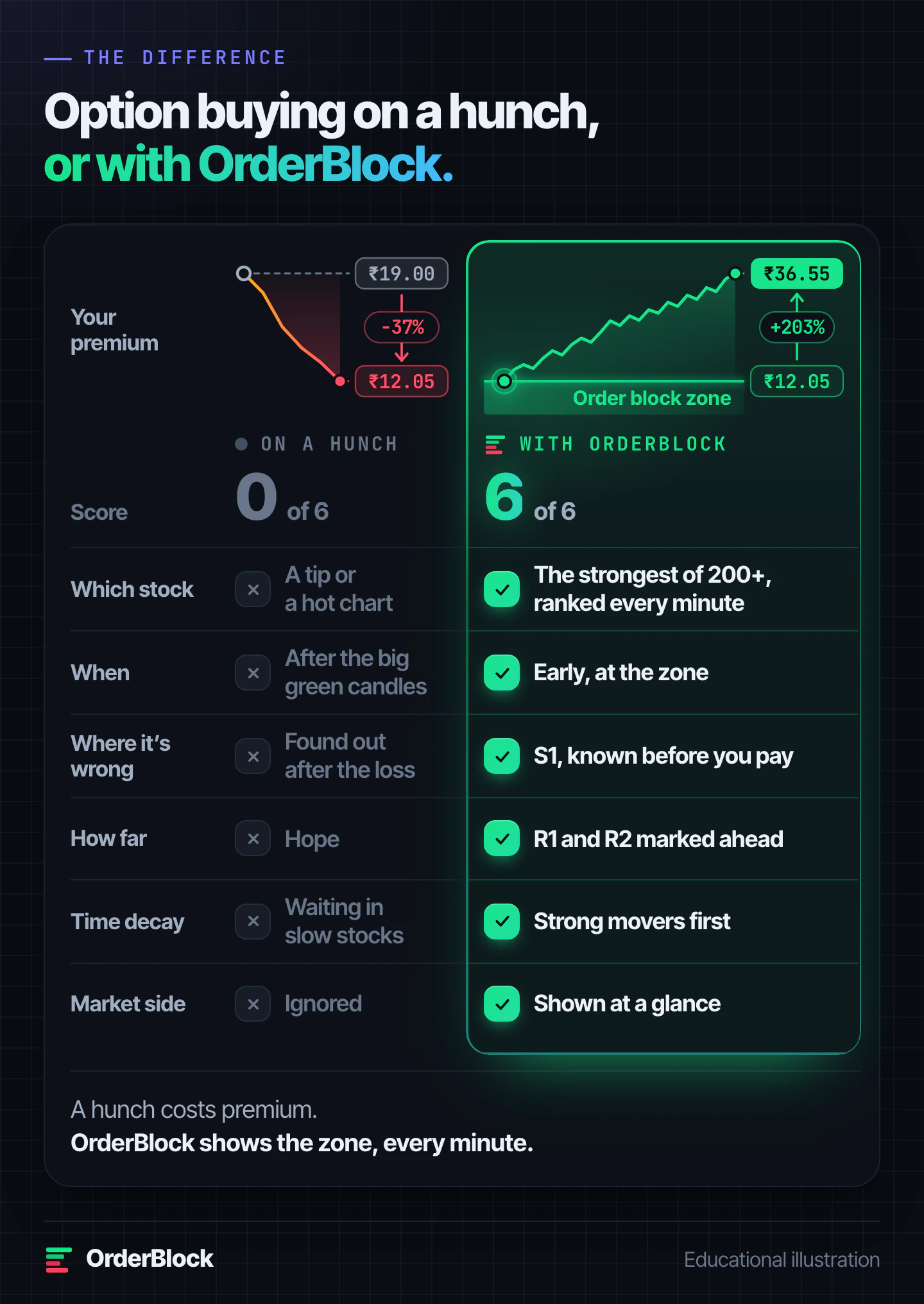
On a hunch, you pay the premium first and hope the move comes. With OrderBlock, you see the stock, the zone, the room ahead and the level where the idea is wrong, before the premium is paid. Small capital can't afford guesswork.
Option buying with small capital: patient, early, consistent
Option buying favours the trader who is early and patient. A clear line at S1 shows where the idea is wrong. R1 and R2 show the room ahead. And strong stocks first means less premium burnt waiting in slow ones.
Consistent option buying doesn't come from one lucky tip. It comes from the same strict rules on every stock, every minute, every day, and from sizing each trade so a break of S1 costs only a small part of your capital. Our guide to position sizing and the journal loop shows how. That is how small capital stays in the game and gets its chance at the big move, one clear zone at a time.
You now know what an order block is, what liquidity is and why the minute matters. The hard part is finding a real zone live, on the right stock, before the premium runs. That is the job OrderBlock does for you, every minute. Every decision stays yours.
A whole day of OrderBlock costs less than one late trade like the one in our story. Get OrderBlock and see the zones live